Similarity

Maths · Geometry. The idea in plain words, the rules to remember, the mistake to avoid and a worked example, written and checked by Mega Lecture.

Test this topic freeAll Maths topics

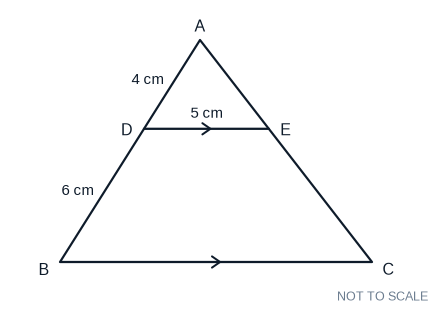
Triangle ABC with D on AB and E on AC, DE parallel to BC; AD is 4 cm, DB is 6 cm and DE is 5 cm.

The idea

Two shapes are similar when one is an enlargement of the other. Their matching angles are equal and their matching sides are all in the same ratio. This ratio is the scale factor.

Two triangles are similar if two pairs of angles are equal. This happens when a line is drawn parallel to one side of a triangle, and when two straight lines cross between parallel lines. Match the sides that are opposite equal angles.

Areas and volumes do not grow at the same rate as lengths. If every length is multiplied by k, every area is multiplied by k2 and every volume by k3.

In simpler words

Two shapes are similar when one is a bigger or smaller copy of the other. Their angles are the same and every length has been multiplied by the same number, called the scale factor. To find a missing side, find the scale factor from two matching sides, then multiply. Area grows faster than length: if lengths are doubled, area is four times bigger and volume is eight times bigger.

An everyday comparison

Similar shapes are like a photo and its enlargement. Every length is stretched by the same amount, so the picture looks identical but larger. Double the length of a photo and it needs four times the paper, because area has two directions that both double. A model and the real building need eight times the material, because volume has three. The comparison stops at distortion: stretch a photo sideways only and the shape changes, so the two are not similar.

Rules to remember

Common mistake

In a triangle with a parallel line, students use AD/DB as the scale factor. The sides of the big triangle are the whole lengths, so use AD/AB, where AB = AD + DB.

In the exam

State why the shapes are similar: 'two pairs of equal angles, so triangles ADE and ABC are similar'. Write the scale factor as large ÷ small for a pair of matching sides, using whole lengths such as AB = AD + DB. Write missing length = matching length × k and show the multiplication. Write 'area scale factor = k2' or 'volume scale factor = k3' before substituting. Going back to length, write k = √(area ratio) or the cube root, then give the answer with units.

Worked example

Two similar jugs have heights 10 cm and 25 cm. The smaller jug holds 0.4 litres. How much does the larger jug hold?

  1. Length scale factor k = 25 ÷ 10 = 2.5.
  2. Volume scale factor = k3 = 2.5 × 2.5 × 2.5 = 15.625.
  3. Larger volume = 0.4 × 15.625 = 6.25.

Answer: 6.25 litres

Ask about this

Type what you are stuck on. The helper finds the explanation, worked examples and the notes to read, free and instant.

Read the full notes

Keep going

← Scale drawingsSymmetry →Take a Maths test