A map has a scale of 1 : 40 000. A lake is 6 cm long on the map. Find the real length of the lake in kilometres.
- Real length = 6 × 40 000 = 240 000 cm.
- Change to metres: 240 000 ÷ 100 = 2400 m.
- Change to kilometres: 2400 ÷ 1000 = 2.4.
Answer: 2.4 km

Maths · Geometry. The idea in plain words, the rules to remember, the mistake to avoid and a worked example, written and checked by Mega Lecture.
A scale tells you how a drawing or map compares with real life. A scale of 1 : 50 000 means that 1 cm on the map stands for 50 000 cm in real life, which is 500 m or 0.5 km. Multiply by the scale to go from the map to real life, and divide to go from real life to the map. Then change the units.
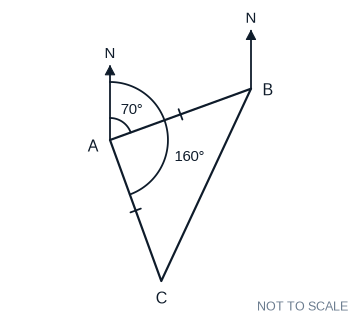
A bearing gives a direction as an angle. It is measured from north, clockwise, and is written with three figures, such as 045° or 210°.
The words matter: the bearing of B from A is measured at A. The bearing back from B to A differs by 180°.
A scale tells you how much smaller a map is than real life. On a 1 : 50 000 map, 1 cm on paper is 50 000 cm in real life, which is half a kilometre. Multiply to go from paper to real life and divide to go back. A bearing is a direction given as an angle. Start facing north, turn clockwise, and write the angle with three figures, like 045°.
A map scale is like a toy car marked 1 : 50. Every part of the real car is 50 times bigger, so measure the toy and multiply by 50. A bearing is like a clock face with north at 12: you always turn the way the hands go, clockwise, and say how far you have turned. The comparison stops at the numbers: a clock goes round to 12, but a bearing goes round to 360°, written with three figures.
Students measure the bearing at the wrong point or turn anticlockwise. For the bearing of B from A, stand at A, face north and turn clockwise until you face B.
Write the scale as a sentence first: '1 cm represents 50 000 cm = 0.5 km'. Show the measured length, then the multiplication or division, then the real answer with units. For a bearing, write 'bearing of B from A', draw the north line at A, measure clockwise and give three figures. For a back bearing, write 'add 180°' or 'subtract 180°' before the answer. When drawing, state the scale you have used and mark the north line. For area, write 'scale squared' and show that step.
Answer: 2.4 km
Type what you are stuck on. The helper finds the explanation, worked examples and the notes to read, free and instant.