
Ecological niches

Biology · B Form and function. The idea in plain words, the rules to remember, the mistake to avoid and a worked example, written and checked by Mega Lecture.

Test this topic freeAll Biology topics

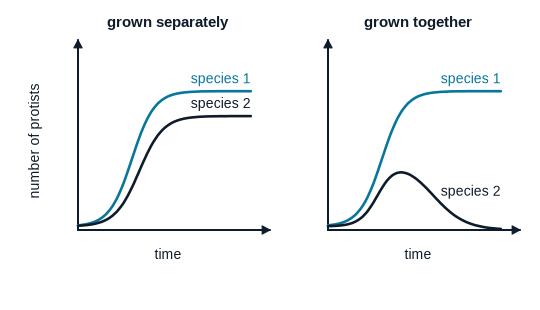
Two graphs of number of protists against time for two species that feed on the same bacteria: grown separately, both populations grow and level off; grown together, species 1 grows and levels off while species 2 rises at first and then dies out.

The idea

An ecological niche is the role of a species in its ecosystem. It includes where the species lives, how it gets its food and energy, the abiotic conditions it tolerates and how it interacts with other species.

The fundamental niche is the full range of conditions and resources a species could use if it had no competitors. The realized niche is the smaller part it actually uses when other species are present.

Two species cannot share exactly the same niche for long. One will use the resources better and the other will die out or move to a different niche. This is competitive exclusion.

In simpler words

A niche is a species' role in its ecosystem. It includes where it lives, how it gets food and energy, what conditions it can stand and how it gets on with other species. The fundamental niche is everything it could use alone. The realized niche is the smaller part it actually uses with competitors. Two species cannot share exactly the same niche for long.

An everyday comparison

Think of a job description. It lists the tasks, workplace and working conditions of a role. The fundamental niche is every job you could do; the realized niche is the job you actually get when others compete. Two people cannot hold exactly the same job forever. The comparison stops working because species do not apply for roles; competition decides which survive.

Rules to remember

Common mistake

Students mix up the two niches. The realized niche is never larger than the fundamental niche: competition can only take part of it away.

In the exam

Define an ecological niche by its parts: habitat, feeding and energy, abiotic tolerance and interactions. Distinguish fundamental and realized niches, and explain that competition reduces the realized niche. State the principle of competitive exclusion: two species cannot occupy the same niche indefinitely; one outcompetes the other, which dies out or shifts niche. Use a named example. Link each point to the data or scenario given in the question.

Worked example

A bacterium is stabbed deep into a tall tube of nutrient agar. After incubation it has grown only at the bottom of the tube. How is it classified?

  1. Oxygen diffuses in from the air, so there is most oxygen at the top and almost none at the bottom.
  2. The bacterium grows only where oxygen is absent, so oxygen stops its growth.
  3. An organism that cannot grow in the presence of oxygen is an obligate anaerobe.

Answer: It is an obligate anaerobe.

Ask about this

Type what you are stuck on. The helper finds the explanation, worked examples and the notes to read, free and instant.

Read the full notes

Keep going

← Adaptation to environmentEnzymes and metabolism →Take a Biology test