
Trigonometric ratios and identities

NUST NET Maths · Maths · Trigonometry. The idea in plain words, the rules to remember, the mistake to avoid and a worked example, written and checked by Mega Lecture.

Test this topic freeAll NUST NET Maths topics

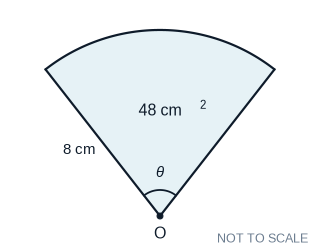
Shaded sector of a circle with radius 8 cm, area 48 square centimetres and angle theta at the centre.

The idea

Angles are measured in degrees or in radians, where π radians = 180°. The formulas for arc length and sector area work only with the angle in radians.

An identity is true for every angle. The test expects you to know the basic identities and the compound, double and half angle formulas by heart, and to spot which one turns the question into known values. Exact values such as sin 15° or tan 75° come from writing the angle as a sum or difference of 30°, 45° and 60°.

For angles like π ± θ or π/2 ± θ, find the quadrant to fix the sign. The ratio stays the same for π ± θ and changes to its co-ratio for π/2 ± θ.

In simpler words

Angles can be measured in degrees or in radians; half a turn is 180 degrees or π radians. An identity is a trig fact that is true for every angle, like sin squared plus cos squared equals one. The exam gives you an awkward angle and expects you to break it into friendly angles like 30, 45 and 60 degrees, then use a formula. Check the quadrant to get the sign right.

An everyday comparison

The identities are like a set of spanners. The question gives you a bolt, a strange-looking expression, and you look for the spanner that fits: a double angle formula, a compound angle formula, or the Pythagorean identity. Finding sin 15° by writing 45° − 30° is like reaching a shelf by standing on two boxes you already have. The comparison stops here: unlike spanners, two different identities often fit the same bolt, and either gives the right answer.

Rules to remember

Common mistake

Getting the sign wrong in cos(α ± β). The sign in the middle is opposite to the one in the bracket: cos(α + β) = cos α cos β − sin α sin β.

In the exam

For conversion, write the fact π radians = 180°, then multiply and simplify. For arc length or sector area, convert to radians first, write l = rθ or A = ½r2θ, substitute, give units. For exact values, write the angle as a sum or difference of 30°, 45° and 60°, state the compound angle formula, substitute the exact ratios, and simplify the surds. For an identity proof, start from one side, name each identity you use, and finish by stating that it equals the other side.

Worked example

α and β are acute angles with sin α = 3/5 and cos β = 5/13. The value of sin(α + β) is

  1. From the 3, 4, 5 triangle cos α = 4/5; from the 5, 12, 13 triangle sin β = 12/13.
  2. sin(α + β) = sin α cos β + cos α sin β = (3/5)(5/13) + (4/5)(12/13).
  3. = 15/65 + 48/65 = 63/65.

Answer: 63/65

Ask about this

Type what you are stuck on. The helper finds the explanation, worked examples and the notes to read, free and instant.

Read the full notes

Keep going

← ProbabilityTrigonometric graphs, triangles and equations →Take a NUST NET Maths test